


.svg)
Free PCOS Symptom Tracker: AI-Powered Insights About Your Hormone Health
A free PCOS/PMOS symptom tracker to log your symptoms and map trends.
I have five years of data about my menstrual cycle. I've conceived twice in that time, and I can point to the exact date both times because I've been so rigorous about tracking that my body has become something I can actually read.
That level of clarity didn't happen overnight and I don’t just have a great memory. It came from logging what was happening in my body whether I felt like it or not.
If you have polyendocrine metabolic ovarian syndrome, PMOS (formerly PCOS) you already know that your cycle doesn't always play by the rules. Irregular periods, unpredictable ovulation, and a constellation of PCOS symptoms that shift from month to month can make your body feel like a mystery you'll never solve. But here's what five years of tracking has taught me: we have natural patterns and we have triggers.
Why Tracking Matters More When You Have PMOS/PCOS
The unfortunate reality is that very few healthcare professionals are true experts in PCOS. Historically, the condition has been dramatically underdiagnosed. People wait years, even decades, for answers. You may have a doctor who is supportive but not specialised, or one who dismisses your symptoms entirely. On more than one occasion I’ve had birth control pills shoved in front of me when I tried to make sense of a troubling symptom.
When you become the most rigorous record-keeper of your own health, you walk into every appointment with evidence. You stop relying on memory ("I think my last period was... six weeks ago? Maybe seven?") and start speaking in data. I remember a gynecologist once telling me she doesn’t believe I have PMOS, I only had polycystic ovaries. That’s because I sat before her with regular periods and clear skin. I walked her through my protocol and how my symptoms had shifted dramatically since I implemented a few lifestyle changes.
Symptom tracking is one part of a full PCOS management plan. It works in concert with nutrition, movement, stress management, and whatever medical treatment is right for you. All of these help you become the expert on your own body that no one else is going to be for you.
What You're Actually Looking For
Tracking helps you do two things: identify your triggers and recognise your patterns.
Triggers are the things that make your PCOS symptoms worse. Stress, certain foods, poor sleep, over-exercising, under-eating. Patterns are the rhythms your body keeps even when they feel chaotic. Maybe your symptoms flare in the two weeks before your period. Maybe your energy crashes on the same days each cycle. Maybe your skin breaks out like clockwork after a stressful week.
You won't always see any of this after two weeks of tracking. But after a few months the picture becomes clearer. I now know that I eat poorly, drink too much, and skimp on sleep, I’m almost certainly heading for an acne breakout. Too much stress? I can almost count on my period being late.
What to Track
Remember you don't need to track everything at once. Build the habit first, then layer in more detail. When I started tracking, I only logged my period start and end dates. Eventually, I added cervical mucus.
The essentials:
- Period start and end dates
- Flow heaviness (light, medium, heavy, spotting)
- Pain levels (cramps, pelvic pain, headaches)
- Mood and energy (even a simple 1–5 scale is useful)
When you're ready to go deeper:
- Cervical mucus and discharge changes
- Basal body temperature (BBT) — taken first thing in the morning before getting up, this can help pinpoint ovulation
- Skin changes (acne, oiliness, dryness)
- Bloating and digestive symptoms
- Sleep quality
- Exercise and activity
- Stress level
- Food and caffeine intake
- Any medications or supplements
How to Track
The best tracking method is the one you'll actually use consistently.
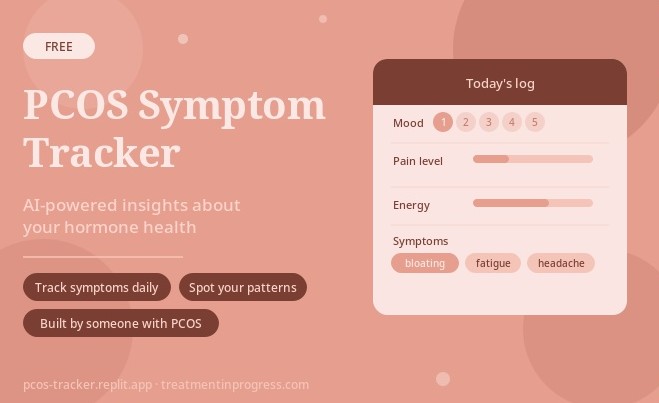
To make this easier, I've built a free symptom tracker you can use right here. No sign-up, no download needed. It's embedded below, and it covers all the essentials we talked about above.
Some people love a dedicated app, and a lot of tools all have features relevant to PCOS. Others prefer a paper journal where they can write freely. Some use a simple spreadsheet. Experiment and stick with the one that works for you.
A few things that have helped me stay consistent:
- Tie it to an existing habit. Log before bed, or right after your morning coffee. Attaching it to something you already do makes it far easier to remember.
- Keep it close to zero friction. If your tracker takes five minutes to open and fill in, you won't do it at 10pm. Make it fast.
- Don't let perfect be the enemy of good. Missed three days? Just pick back up. Incomplete data is still data.
- Review monthly. At the end of each cycle, look back over your entries. This is where the patterns start to reveal themselves.
Whether you're newly diagnosed or years into your PCOS journey, I hope it helps you feel a little less like your body is working against you.
Featured image by cottonbro studio

